Game Development | Graphic Design | 3D Modeling | Illustration
Deploy parasites to hijack bodies and wipe out hospitals of humans.
Created in 48 hours for Ctrl + Alt DMV 2026!
Created in a team of 3. I did all the graphic design, 3D modeling, and UI/UX. My teammates did the programming, game/level design, and music.


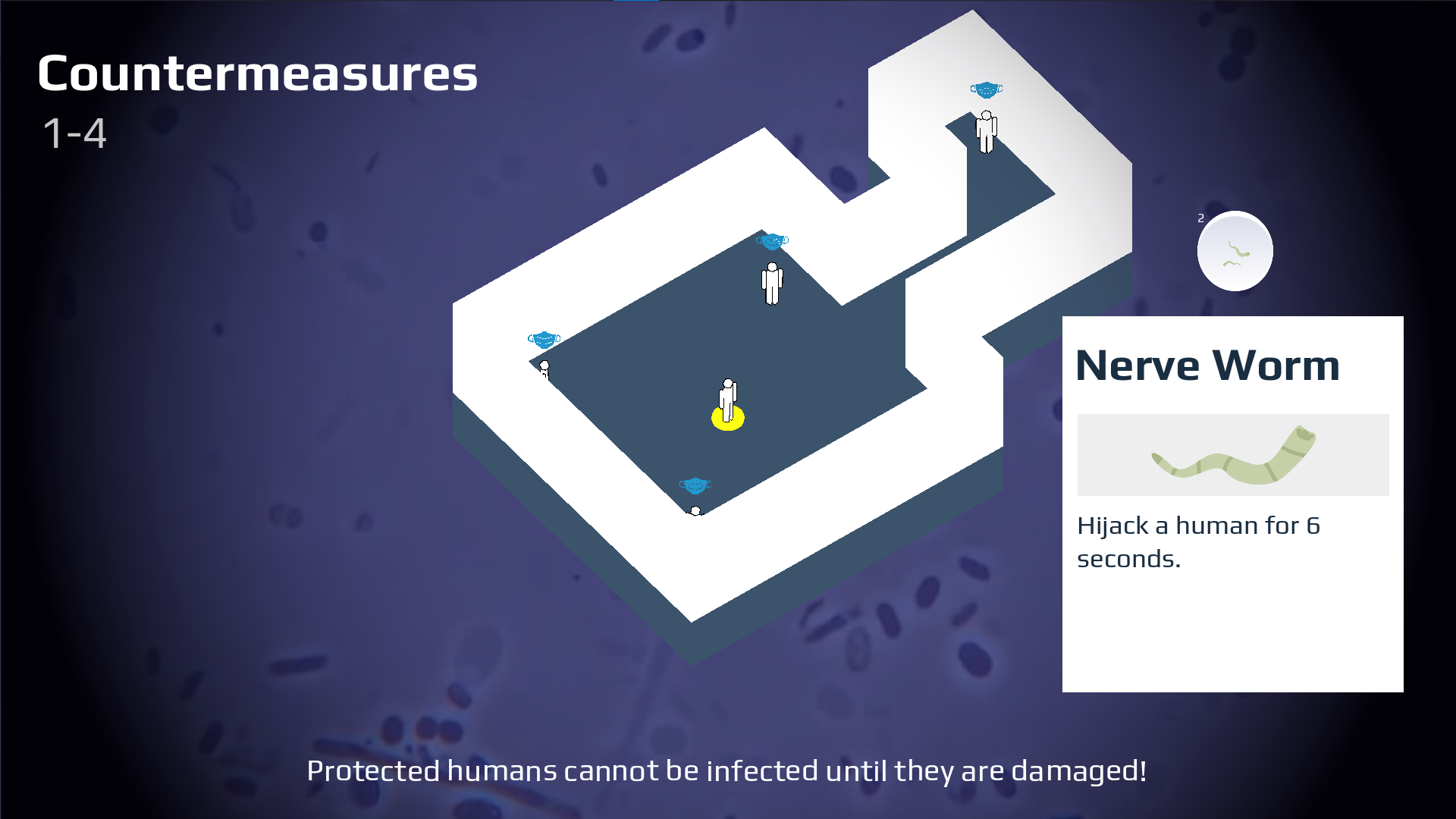
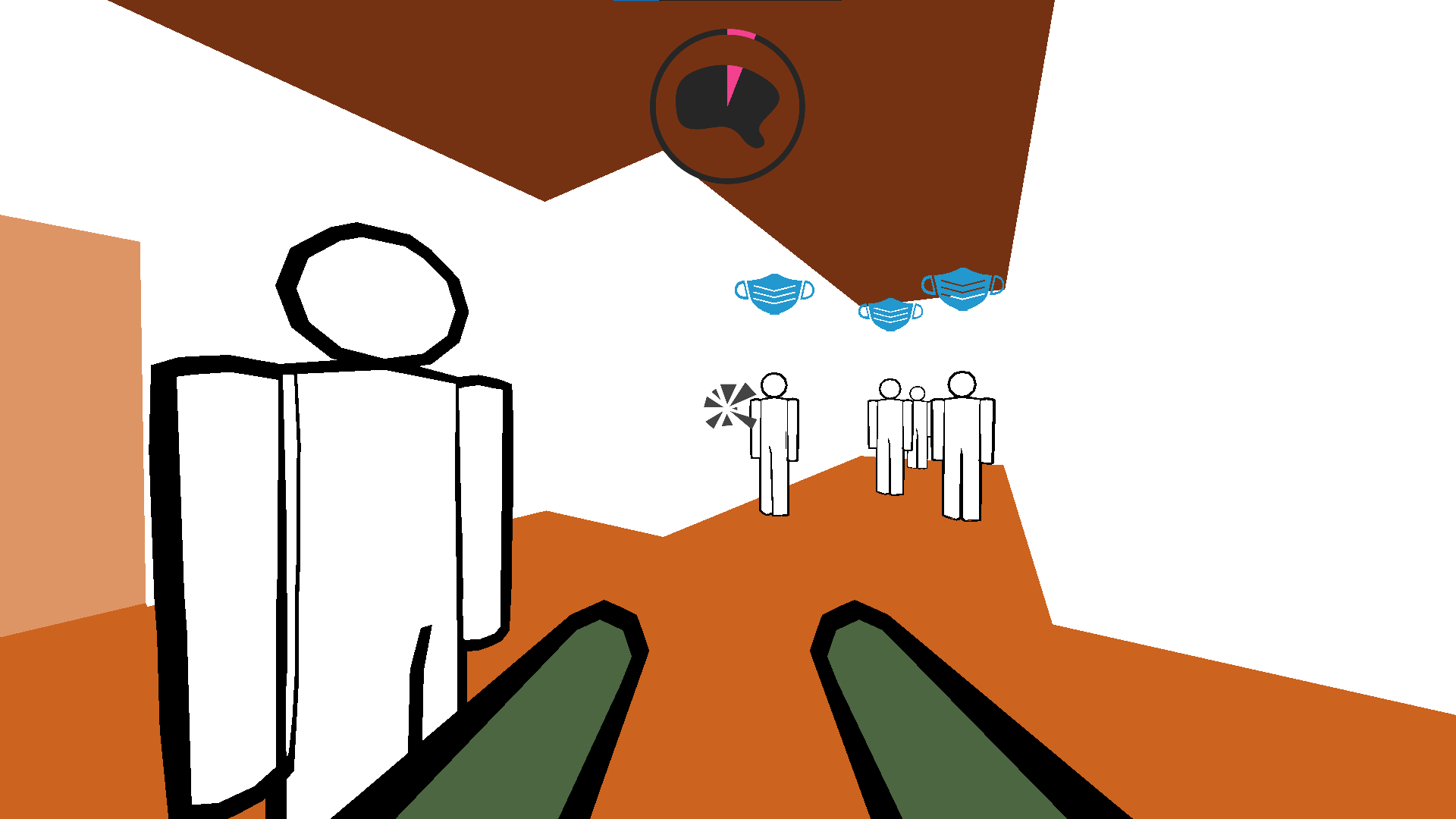
Final game screenshots

After VCGJ #1 in March of 2025 (which I led the graphics for, check it out!), Virginia schools were officially on the game development map. These connections led to an invitation to join CTRL + ALT + DMV, a brand new game jam connecting college students in Virginia, Maryland, and D.C.
This game jam had an especially illusive prize: the top 3 teams won a tour of Firaxis Games (creators of Civilization, XCOM, Marvel’s Midnight Suns, and more!), just north of Baltimore, MD. This was an incredible opportunity, so we had to give it our all. I teamed up with Leo Torrijos (creator of trashmonger games), and Elijah Cannon, a programmer and chiptune composer.
Fast forward to February 27th, the day the jam started. I was excitedly watching the theme announcement livestream on my phone in the student union while eating an okay burger.
The theme? Parasite.
With only 48 hours to complete the game, we could waste no time deciding what type of game to make.
After a brief group discussion, we decided on a direction and general gameplay loop and got to work.
Our game's premise: strategically wipe out hospitals by deploying parasites. This would be done in a unique way - selecting an individual to infect in a bird's eye 3rd person view, then switching to 1st person and attacking everything.

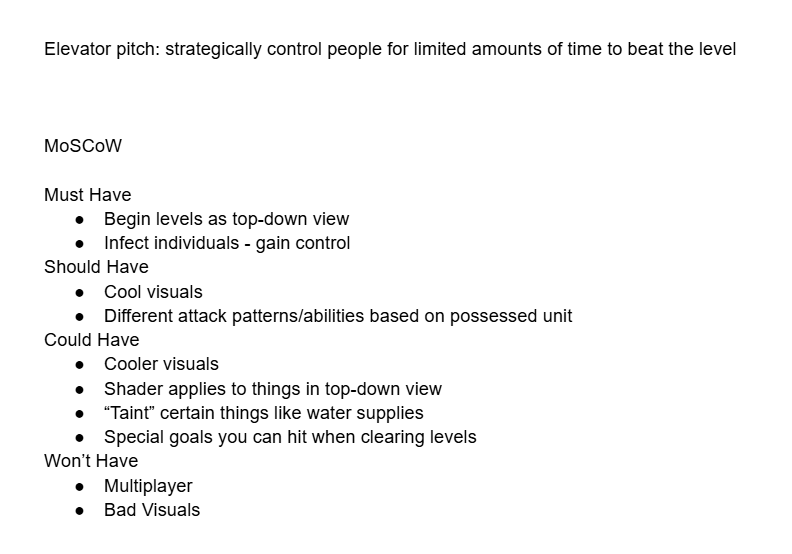
Our initial notes. MoSCoW is a technique I practice in game development to help determine the scope of a game. This is especially important during game jams, where scope creep can destroy the chances of your game performing well.
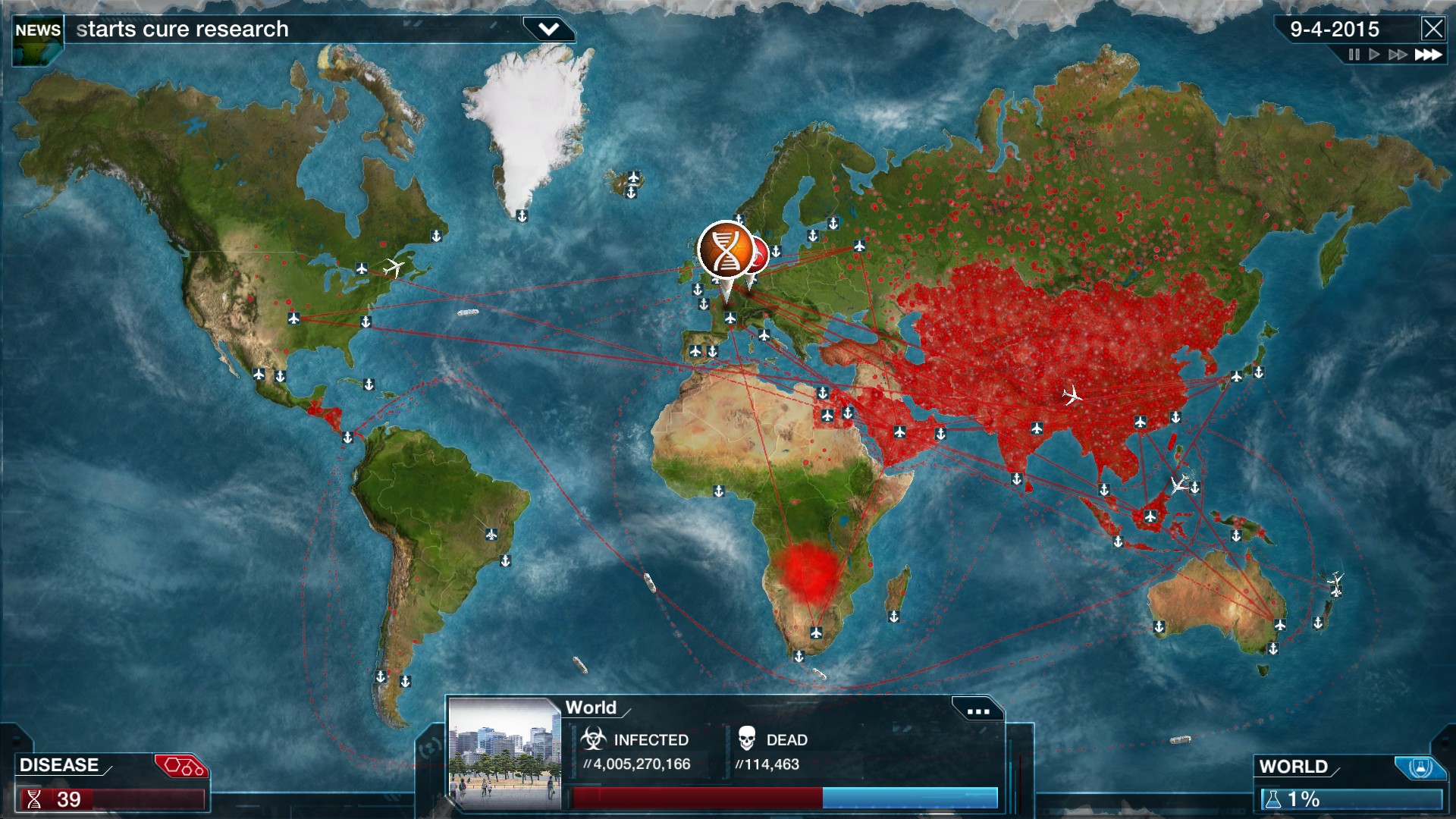
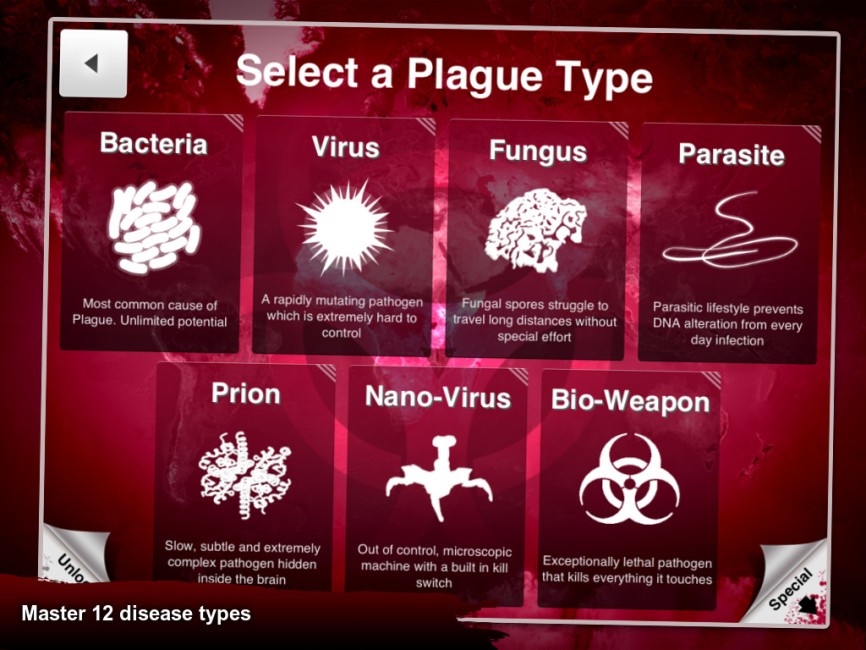
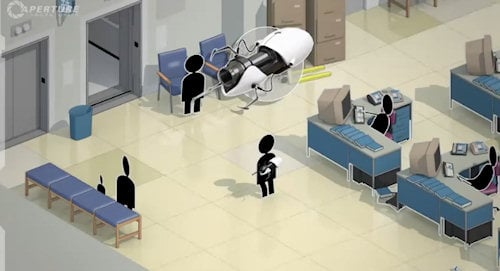
For a game about parasites and infecting everything, we were inspired by Plague Inc., a game with a similar theme that also features a top-down approach (on a much larger scale). Our team also liked the animated shorts for Portal 2, which feature an orthographic view and an ironic, disposable view of people.

Plague Inc. Evolved overworld map

Plague Inc. plague selection

Portal 2 animated short screenshot
I quickly began trying to pinpoint how our game should look and feel. It was important to establish this look early on, as we needed to prototype to ensure we could actually code the game to match the way we wanted it to look.
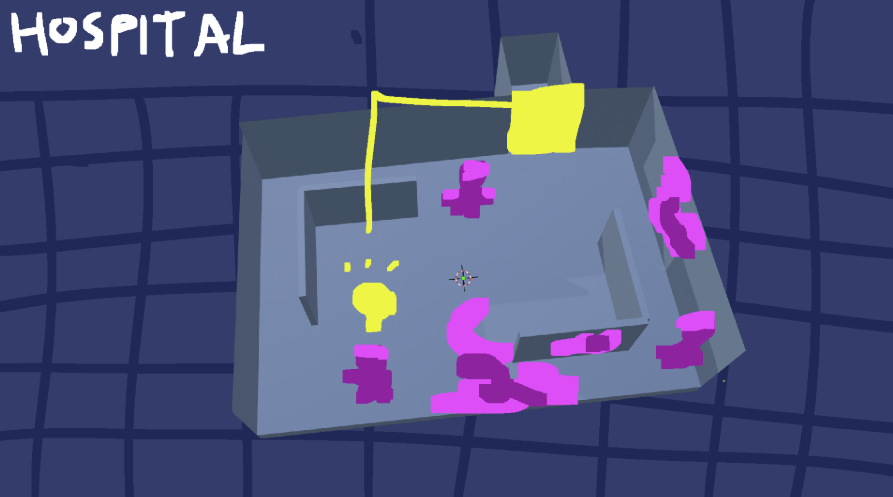
Initial sketch of 3rd person view
To create this mockup, I modeled a room in Blender (a free 3D software), screenshotted it, and pasted it into Krita (a free drawing software).
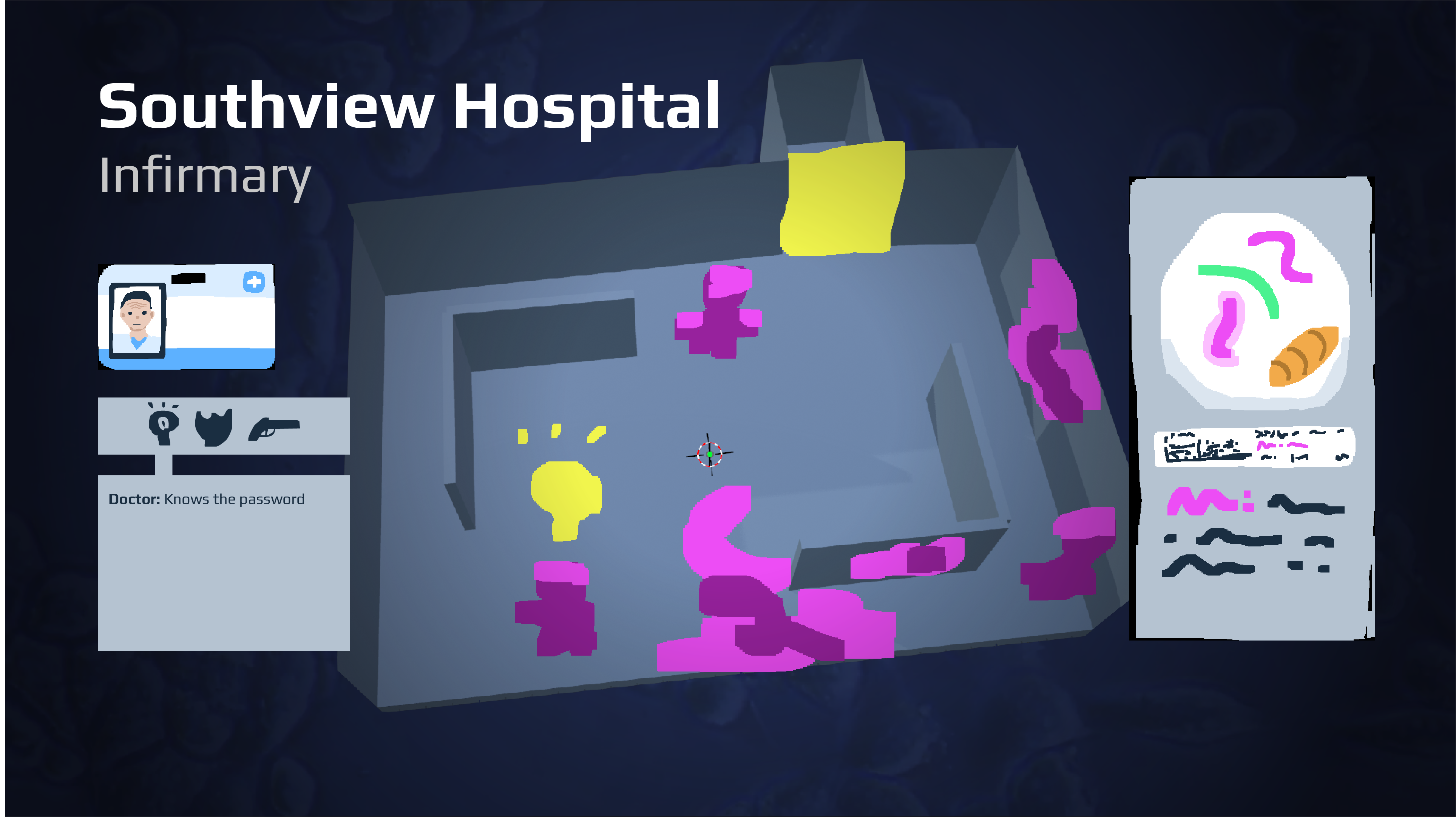
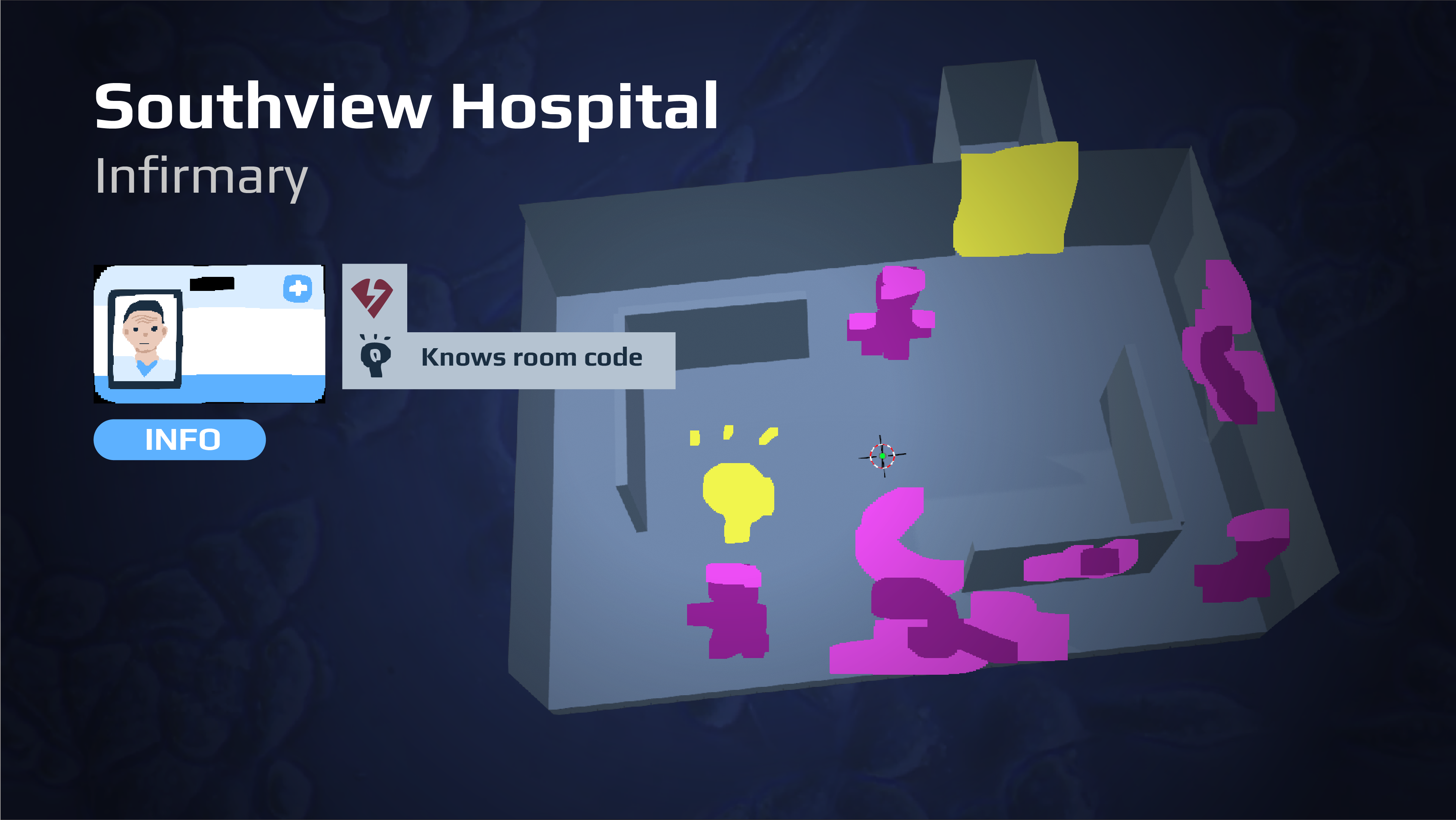
The purple blobs represent individuals that you can possess as a parasite. The yellow represents "knowledge", a scrapped concept that I will discuss more later on.
I wanted to include the title of the level in the top left. We initially wanted distinct sections of a hospital (ICU, pharmacy, waiting area, etc.), but we scrapped it because we felt it wasn't necessary relative to the time we had to work on it.
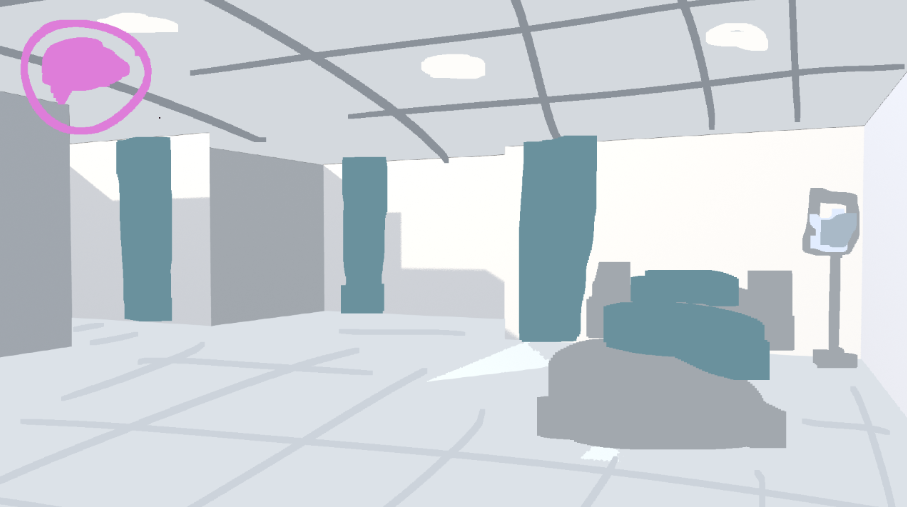
Initial sketch of 1st person view
A sketch of how the hospital interior could look. Initially, parasite/human guts were going to get everywhere, so having a lot of white would help that stand out. We scrapped having detailed interiors in favor of a more abstracted look, to save time. (The 3rd person view was always going to look more abstracted, so might as well, right?)
The icon in the top left is a timer of how long the parasite is infecting the current individual's brain. This made it into the final game, relatively unchanged.
Once the visuals were prototyped, it was time to solve some lingering UI/UX issues. So, I kept creating mockups.
What is knowledge, what design problems did it raise, and why was it scrapped?
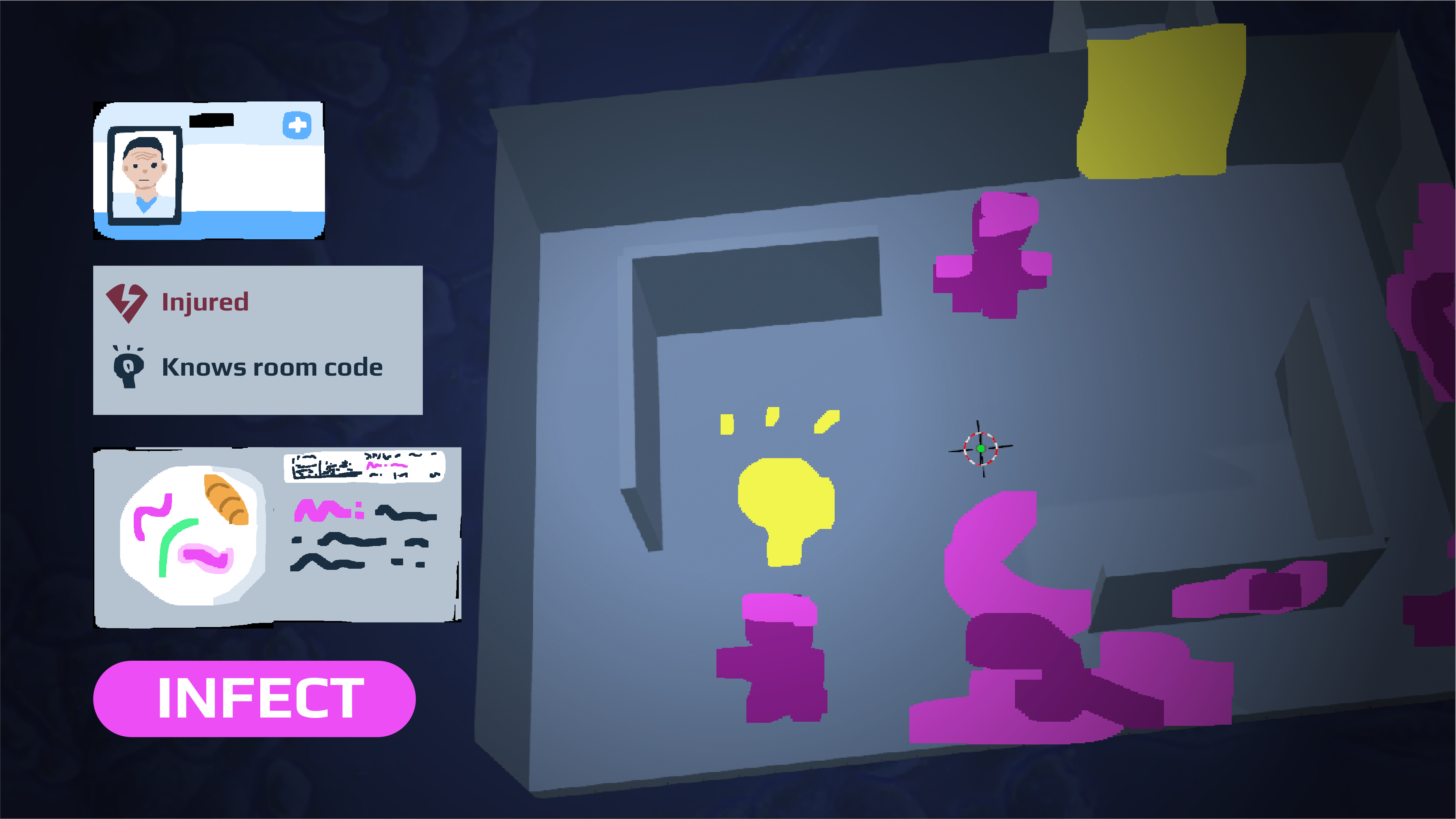
Well, to enhance the puzzle-solving elements of the game, we wanted some individuals to have modifiers that would influence how the player would go about controlling a room. Remnants of this exist in the game (2 different modifiers! Wow!), and are important, but we initially planned for way more. For example, maybe you need to open a door, but only one doctor knows the password to the door, so you need to infect him in order to learn the password. Or, maybe you can infect a security guard and your standard bite/hit attack is replaced with a gun.
The result of this was an incredibly modular system. What if we wanted an individual with a gun, a password, double health, and immunity to infection? You would need to be able to tell if someone has all of those traits. (This is the part when the game designer would say, "Matthew, we'll just not have that." Hindsight is 20/20.)

A more refined sketch that begins to tackles some UI/UX problems.
Besides trying to get modifiers to work, a few other details started blossoming from creating mockups.